
Q&A: How the ECLO service helps people with sight loss
Posted: Friday 13 March 2026
Eye clinic liaison officers (ECLOs) play a vital role signposting patients to information and the support available.
We spoke to Moorfields Eye Hospital ECLO Mary Bortolussi, who joined the team in February 2022, about the impact the role can have on people living with sight loss.
What does an ECLO do?
From signposting to registering someone as visually impaired, the role of an ECLO is both rewarding and hands-on, Mary explained.
She said: "We serve as a link between the hospital, the eye clinic and other external services, for people who are visually impaired. We provide information and advice about living life with sight loss, which we do by referring or signposting patients to the relevant services."
There are also limitations to what ECLOs can do for people, as Mary outlined some of the questions people ask.
She said: "Patients experience difficulties in different areas of their life so it could be that the individual is having difficulties with finding a job, or employment difficulties in general. They may have issues reading and we can provide information on assistive technology and highlighting practical support which is available to them.
"We don’t provide housing services but if someone is visually impaired, we can help them through contacting their local sensory team, who will then, of course, be in charge of supporting their requirements in their home.
"We can provide general information about different eye conditions, but we are also not clinicians; we can’t give clinical advice or treatments."
How I became an ECLO
Mary was diagnosed with retinitis pigmentosa (RP) as a child, and after starting her career as a lawyer, enquired about becoming an ECLO following the experiences she had received as a patient herself.
Mary explained: "My experiences have helped me a lot in terms of understanding patients and their journeys, but at the same time, as an ECLO it's important to recognise that every experience is completely different.
"I am a very positive and a very proactive person which has helped me, so that is a message I always try to communicate to my patients as well. It is so important to be positive and proactive because being visually impaired nowadays is not the same as it was 10 or 20 years ago. Now, we have lots of assistive technology available to make our lives much, much easier.
"But being an eye clinic liaison officer has taught me a lot because I've learned so much from other patients as well. It is such a valuable role because the ECLO is there to listen to you and your feelings, and show you ways of doing things, to carry on with life."
What advice can an ECLO provide?
Mary understands and recognises that people may approach the ECLO service unsure about asking for help, but it can lead to vital support.
"The first thing and the most important thing in the first consultation is to listen what the patient has to say, and then my advice is for them to be proactive and not feel silly asking for help," she said.
"Some people find asking for help embarrassing, but there’s nothing wrong with it, so that’s my best advice. Then I can provide them with information about all the support that is available, so they feel reassured in their journey. It's planting that seed, so they can go at their own pace and decide their next steps about what they need and where to go.
"Reading is a common concern we hear so we try to help people access printed information, and we talk about assistive technology which is available now.
"Then there’s the social aspect of it too with not recognising faces or navigating space, for people with macular disease so then that's when we talk about support from their local sensory team in terms of mobility training and cane training and really trying to help people stay as independent and as safe as possible.
"We can also refer patients on to organisations and I have talked to many patients about the Macular Society, in terms of counselling and for Charles Bonnet syndrome support. So it’s referring them and signposting them to further support which makes a big difference."
What is a typical experience at the eye clinic?
While every patient's sight loss journey is different, every patient who visits their ECLO will be assessed and listened to.
Mary explained: "The first thing that we do is listen to their concerns, to their thoughts, to what they have to say.
"There is an assessment of their circumstances and how they are coping in everyday life and the next steps are then finding out about support services, or liaising with internal departments if the patient needs some help at the hospital. Really, it’s so they are supported if whatever way they need and we take it from there.
"Living with sight loss is a journey for everyone, and it has ups and downs. They may need to be ready to readapt as their sight loss changes, so I’m there to reassure them on that journey and support them at any point.
"I know how it’s so positive to have someone who can listen to you and talk to you. It’s a gamechanger, and that comes from someone who has used the service as a patient themselves. We’re there whenever they need us at any point in their sight loss journey."
How can an ECLO help me register my visual impairment?
Patients wanting to register as visually impaired are normally referred by a clinician but they can also be referred by external organisations such as the Macular Society. Patients can also self-refer.
Registering as visually impaired is an option for people depending on the severity of their sight loss, which can lead to extra help and support in their life.
Mary said: "Patients won’t necessarily know how it works, which doesn’t matter. We’re more than happy to be the ones liaising with the consultant first to get the confirmation before getting their certificate. Both ways are valid and we try to make it as easy as possible."
Can an ECLO help me with macular disease specifically?
Whatever is causing your sight loss an ECLO is there to help you.
Mary said: "With macular disease, it's the struggles with reading, writing, recognising faces and consequently people struggle with reading food labels, prices, letter correspondence, their jobs – all things which are crucial in our lives. So much is impacted, so we discuss assistive technology, talk about the Macular Society itself and the support groups in their communities, and if necessary, counselling support.
"The ECLO service can be game changing; patients go from not being able to read, to suddenly discovering there are tools which can help them, be that a magnifier or settings on your phone or computer, all those things make a huge difference.
"You may find it difficult to adapt, but you can adapt and it gives you so much confidence. It actually helps you realise that you can continue to adapt to new challenges when they arise in the future. You will feel like ‘okay this is a new challenge, but I have done it before and I will try to do this again.’
"And the ECLO service helps people to reach those stages in their journey and wherever they are on that journey, we are there to help them."
How can I contact my nearest ECLO?
You can speak to your consultant about your local ECLO team, or contact the Macular Society Helpline on 0300 3030 111, or email help@macularsociety.org
For those in London, Mary can be contacted on email: maria.bortolussi@nhs.net
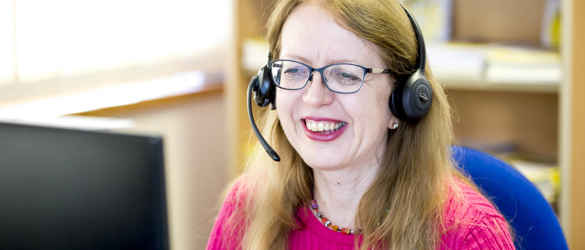
Macular Society Helpline


Free information and support to those with macular disease, along with their family and friends, to help people retain their independence.

Free counselling and emotional support for sight loss
Struggling to cope with macular disease or sight loss? Get free, confidential counselling from trained professionals. Emotional support for individuals and carers.
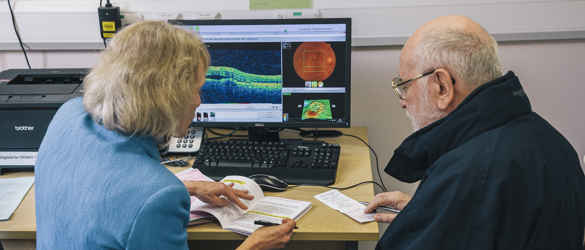
The benefits of registering as sight impaired
If you have a permanent visual impairment, you may be eligible to be registered as sight impaired.